
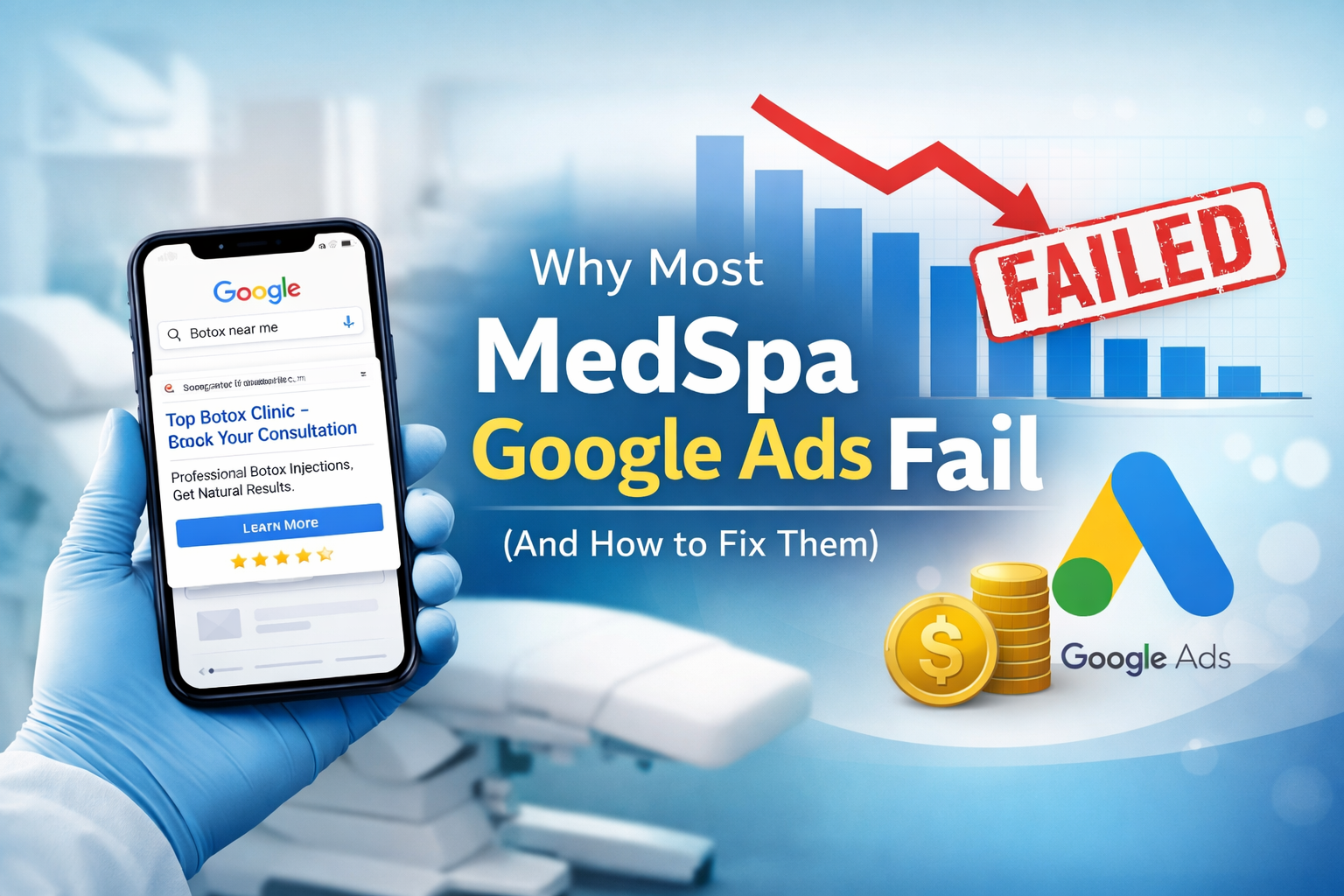
Medical spas invest thousands of dollars every month into Google Ads expecting a steady flow of new patients. The logic seems simple: people search for treatments like Botox, laser hair removal, or Morpheus8, your clinic appears at the top of Google, and bookings follow.
But for many clinics, that’s not what happens.
Instead, they experience high ad spend, inconsistent leads, and disappointing ROI. Some clinics even abandon Google Ads completely after a few months because they believe the platform “doesn’t work for medspas.”
The truth is very different.
Google Ads can be one of the most powerful patient acquisition channels for medical spas when implemented correctly. The problem is that most campaigns are structured poorly, targeting the wrong audience, sending traffic to ineffective pages, and failing to track what actually drives revenue.
Let’s break down why most MedSpa Google Ads campaigns fail and more importantly, how to fix them.
One of the biggest mistakes medspas make is assuming that Google Ads works like traditional advertising.
In reality, Google Ads is not simply about visibility. It is about capturing high-intent searches at the exact moment someone is looking for a treatment.
When someone types:
they are often ready to book.
However, many campaigns are built around broad targeting, generic messaging, and poorly structured ad groups. This causes clinics to pay for clicks from users who are not serious patients.
Instead of attracting people ready to schedule treatments, the ads attract casual researchers, competitors, and irrelevant traffic.
Fixing this starts with understanding search intent.
Successful MedSpa campaigns focus specifically on transactional keywords the searches that indicate someone is ready to take action.
Most failed campaigns begin with the wrong keyword strategy.
Many agencies and clinics target extremely broad keywords such as:
These keywords have huge search volume but very low buying intent. Someone searching “skincare” could be looking for anything from drugstore products to dermatology advice.
The result is wasted ad spend.
A high-performing campaign focuses on specific treatment-based searches such as:
These keywords attract people who are already researching a procedure and are much closer to booking an appointment.
Another critical factor is the use of negative keywords. Without them, your ads may show for irrelevant searches such as:
Filtering out these searches protects your budget and improves lead quality.
Even when ads generate clicks, many MedSpa campaigns fail because they send visitors to the homepage of the website.
This creates friction for potential patients.
Imagine someone searching for “Botox near me” and landing on a generic homepage that lists dozens of services. The visitor now has to find the Botox information themselves, which increases the chances they will leave the site.
Effective campaigns always send traffic to dedicated treatment landing pages.
A strong landing page for a MedSpa treatment should clearly explain:
Most importantly, the page must build trust.
Patients are not only evaluating the treatment they are evaluating the clinic. High-performing pages typically include practitioner credentials, testimonials, real patient photos, and clinic certifications.
Without these trust elements, visitors often continue searching and choose a different clinic.
Generating clicks is only half the equation. The real goal of Google Ads is conversions, meaning actual consultations and bookings.
Many clinics overlook the importance of conversion optimization.
For example, a landing page may require users to fill out a long contact form with multiple fields. In a world where users expect instant results, this creates unnecessary friction.
Successful campaigns prioritize simplicity.
Most high-performing medspa landing pages offer multiple easy ways to convert:
The easier it is for someone to contact the clinic, the more leads the campaign will generate.
In addition, fast response time is critical. Studies consistently show that leads contacted within the first few minutes are far more likely to convert into patients.
Even the best advertising campaign will struggle if inquiries sit unanswered for hours.
Another common issue is overly broad geographic targeting.
Some clinics run ads across entire regions or provinces, even though most patients only travel a limited distance for treatments.
For most MedSpas, the real patient radius is typically 5–15 kilometers depending on the city and the service offered.
Advertising too broadly causes the budget to be diluted across areas where people are unlikely to visit the clinic.
Optimized campaigns focus on specific neighborhoods, cities, or postal codes where ideal patients live.
This is particularly important in large metropolitan areas where multiple clinics compete for the same search traffic.
A well-structured geographic strategy ensures the advertising budget is concentrated where it matters most.
One of the most dangerous mistakes in MedSpa advertising is running campaigns without proper conversion tracking.
Without tracking, it becomes impossible to answer the most important question:
Which ads are actually generating patients?
Many clinics simply monitor impressions and clicks. While these metrics may look impressive, they do not indicate real business results.
Proper tracking should include:
Advanced setups even track which keywords and campaigns generate the highest-value patients.
When this data is available, campaigns can be optimized continuously. Underperforming keywords are removed, budgets shift toward the most profitable treatments, and overall ROI improves.
Without tracking, advertising decisions are essentially guesswork.
Medical aesthetic treatments involve both financial investment and personal trust. Patients often research clinics carefully before committing.
Ads that focus only on price or generic messaging tend to perform poorly.
Instead, successful campaigns address the concerns and motivations of potential patients.
For example, someone searching for Botox is often thinking about results, safety, and practitioner expertise. Ads that emphasize these factors tend to perform significantly better.
Messaging that highlights physician oversight, years of experience, natural-looking results, or advanced technologies can dramatically improve click-through rates and conversions.
This is where strategic copywriting becomes essential.
Google Ads is not just a technical platform it is also a communication tool that must resonate with patient psychology.
When structured correctly, Google Ads can become a predictable patient acquisition engine.
Successful campaigns typically follow a clear framework.
First, they target high-intent treatment keywords that indicate strong buying intent.
Second, each treatment has its own tightly structured ad group and dedicated landing page. This alignment between keyword, advertisement, and landing page dramatically improves relevance and conversion rates.
Third, campaigns use data to guide decisions. Conversion tracking, call tracking, and lead analysis provide the insights needed to continuously refine performance.
Over time, this creates a feedback loop where campaigns become increasingly efficient.
Clinics that implement these systems often discover that Google Ads becomes one of their most reliable growth channels.
The ultimate objective of MedSpa advertising is not simply generating traffic.
The real goal is building a consistent system that turns searches into consultations and consultations into patients.
When Google Ads campaigns are optimized correctly, they provide something every clinic wants: predictable growth.
Instead of relying solely on referrals or social media, clinics can tap into a steady stream of high-intent patients actively searching for treatments.
For many MedSpas, this can be the difference between sporadic bookings and a consistently full schedule.
Google Ads does not fail for MedSpas because the platform is ineffective.
It fails because most campaigns are built without a clear strategy, proper targeting, or optimized conversion systems.
When campaigns focus on the right keywords, direct traffic to effective landing pages, track real conversions, and align with patient psychology, the results can be transformative.
For clinics looking to grow their patient base, Google Ads remains one of the most powerful marketing channels available but only when implemented with the right approach.




.jpg)


